
 In our last two installments, I mentioned how Knute Rockne compiled four sophomore football players in the Notre Dame backfield who became football lore. The Four Horsemen of Notre Dame destroyed almost any defense they faced from 1922 to 1924, only losing twice to Nebraska.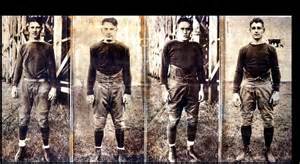
In a strange way, their image came to me when reading Richard P Rumelt’s Good Strategy/Bad Strategy and his four major aspects of bad strategy. Rumelt writes that you can detect bad strategy out of four hallmarks: “fluff, failure to face the challenge, mistaking goals for strategy, and bad strategic objectives.”
In this issue, we will discuss the third horseman, “mistaking goals for strategies.” Many bad strategies are just statements of desire rather than plans for overcoming obstacles. Many companies express their desires as goals, not strategy. For example:
- We will be the industry company of choice
- We will grow our revenues 10% per year
- We will sustain a profit margin of 15% per year
The problem with this kind of pseudo strategic thinking is that it is looking at the trophy, not the method to earn it. A simple example is using two components of the SWOT tests (strengths, weaknesses, opportunities, and threats.) What strengths and opportunities are you going to use to build a strategy to get to those goals?
If you have a difficult time distinguishing a goal from a strategy, always think of a tightrope walker. Their goal, or vision, is to get to the other platform. Their use of a wire, training, a balancing pole, and other aspects feed into the overall strategy that will get to the other side.
But do we ignore numbers? Absolutely not. Metrics work as milestones or sign posts along the way. They can have the effect of measuring the strategy and altering tactics that can get you to your vision. But for these metrics to mean something there has to be an action that creates the conditions that will allow the company to reach its visionary goals.
Performance goals have little to do with strategy. But the real challenge is thinking strategically. Take the military, for example. Would this be a proper response by General Eisenhower to President Roosevelt in his strategy to defeat the Germans in WWII? “Mr. President, we plan to defeat the Germans in six months.” His response stated a goal, but not a strategy to getting to that goal.
The same can be said on how individuals “strategize.” In Los Angeles, a singer may say, “I want to get a recording contract.” Or, “I want to earn five platinum records by time I am 35.” These are not strategies, they are goals. The challenge is to go through the process of creating a basic roadway. This roadway joins where you are now to where you want to be.